Search behaviour is shifting in a way that traditional SEO strategies were not built to address. More users today
bypass search engines entirely and go straight to AI tools like ChatGPT, Google Gemini, Microsoft Copilot, and
Perplexity to get their answers. These platforms do not return a list of links. They generate a single, direct
response and cite the sources they consider credible. If your website is not among those sources, you are invisible
to a growing segment of users who will never see your brand in a search result.
This shift has created a new category of digital marketing practice known as AI optimization, also referred to as
Answer Engine Optimization (AEO) or Generative Engine Optimization (GEO). It is distinct from traditional SEO but
complements it. Where SEO focuses on ranking in search results pages, AI optimization focuses on being selected as
a trusted source by AI platforms that synthesise and summarise information on behalf of users.
How AI Search Engines Choose Their Sources
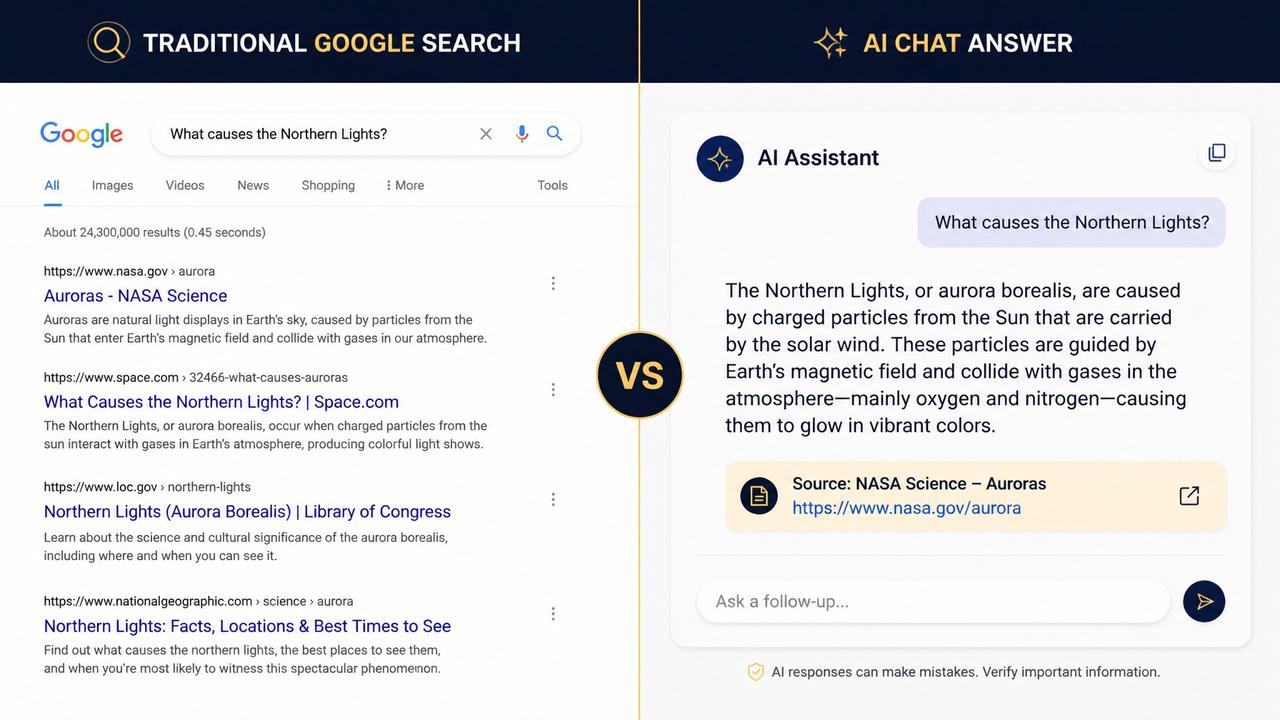
Figure 1: Traditional search vs AI-generated answer — the shift in how users find information.
“By the time a user follows a citation from ChatGPT or Gemini, they are already pre-qualified, making AI-driven traffic not just larger in potential, but significantly higher in quality.”
AI platforms like ChatGPT and Google Gemini do not crawl the web independently in the same way traditional search
engines do. ChatGPT pulls from Bing's index alongside its own training data. Gemini draws on Google's search index.
Perplexity prioritises recent, clearly written, and citation-friendly content. Across all three, the common factor
is trustworthiness. AI models are trained to surface sources that demonstrate expertise, consistency, and authority
within a specific topic area.
For a business in Malaysia, this means that appearing in AI-generated answers requires more than good keyword placement.
It requires building a content profile that signals genuine knowledge about your industry.
What AI Optimization Requires
- Write content that answers specific questions your target audience is likely searching for. Focus on clarity and directness over length.
- Use structured headings and short paragraphs. AI tools extract answers from content that is easy to parse and logically organised.
- Update content regularly. Freshness is a strong signal across AI search platforms, particularly for time-sensitive topics.
- Publish case studies, data, and insights that demonstrate real expertise. Generic content does not rank in AI responses.
- Maintain consistent messaging across your website, LinkedIn, industry publications, and business directories. AI platforms aggregate signals from multiple sources when assessing authority.
Why This Matters for Businesses in Malaysia
For software companies and digital service providers in Malaysia, AI search optimization represents an early-mover opportunity. Procurement officers, business owners, and decision-makers are increasingly using AI tools to research vendors before making contact. Companies that appear in AI-generated answers during that research phase are already ahead of competitors who are relying solely on traditional search engine rankings.
AI-driven traffic also tends to be higher quality. A user who arrives at your site via an AI citation already understands
what your business does. The visit is intentional, and the likelihood of inquiry is significantly higher than from a
standard organic search click.
AI optimization is not a replacement for SEO. It is the next layer of it. Businesses that address both will
consistently outperform those that focus on only one.